
When you run a business, there is never a shortage of things to manage. Staying current on evolving GHS and OSHA Hazard Communication Standard (HazCom) requirements can feel complex, especially when it comes to maintaining accurate Safety Data Sheets (SDSs) across teams, facilities, and suppliers.
Effective SDS maintenance is not just about compliance; it ensures employees have immediate access to accurate chemical hazard information and supports safer, more informed decision-making across the organization.
Modern compliance teams increasingly rely on digital solutions such as the TotalSDS by Enhesa SDS Manager platform to centralize SDS access, improve version control, and reduce the administrative burden of maintaining compliance at scale.
What is a Safety Data Sheet (SDS)?
Safety Data Sheets (SDSs) are standardized documents that provide detailed information about chemical products, including their hazards, safe handling procedures, storage requirements, and emergency response measures.
Each SDS helps answer critical workplace safety questions such as:
- What is the chemical product?
- What hazards does it present?
- How should it be safely handled and stored?
- What steps should be taken in an emergency?
Under OSHA’s Hazard Communication Standard (HCS), employers must ensure that SDSs are available for hazardous chemicals in the workplace and accessible to employees at all times. Learn more about OSHA training and compliance here.
Are Safety Data Sheets Mandatory?
In most cases, yes. SDS requirements are governed by OSHA in the United States under the Hazard Communication Standard (29 CFR 1910.1200), which requires chemical manufacturers and importers to classify hazards and provide SDSs for hazardous chemicals.
However, requirements may vary depending on:
- Product classification
- Intended use of the chemical
- Jurisdictional regulations (OSHA, GHS, WHMIS, REACH, etc.)
Because regulatory frameworks differ globally, organizations operating across regions must ensure SDS compliance is consistently maintained across all applicable standards.
Step 1. Learn & Assign Responsibility
Begin by ensuring your organization understands OSHA’s Hazard Communication Standard and its SDS requirements.
Assign a responsible individual or team to oversee:
- Hazard communication compliance
- SDS tracking and updates
- Employee training coordination
- Program documentation and audits
Clear ownership helps prevent gaps in SDS maintenance and ensures accountability across departments.
Step 2. Prepare & Implement a Hazard Communication Plan
Develop a written hazard communication program that outlines how your organization manages:
- Chemical labeling
- Safety Data Sheets
- Employee training requirements
As part of this process, create a comprehensive chemical inventory using identifiers such as CAS numbers to track hazardous substances and ensure SDS documentation remains current.
Step 3. Label Workplace Chemicals
Proper labeling is a core component of HazCom compliance.
Shipping containers must include:
- Product identifier
- Signal word
- Hazard pictograms
- Hazard statements
- Precautionary statements
- Responsible party contact information
Workplace containers must, at minimum, include chemical identifiers and basic hazard information to ensure employees can quickly understand risks.

Step 4. Maintain and Access SDSs
SDS maintenance is one of the most important—and most frequently overlooked—components of compliance.
Employers must ensure SDSs are:
- Up to date
- Organized and easy to locate
- Accessible to employees during all work shifts
Traditionally, SDSs were stored in physical binders. However, many organizations now transition to digital SDS management systems to improve accessibility and reduce compliance risk.
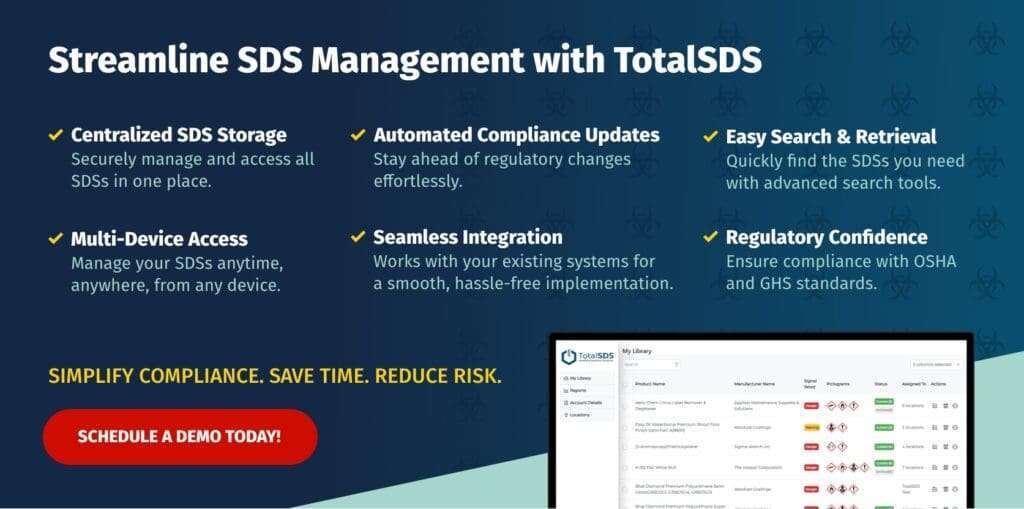
Platforms such as the TotalSDS by Enhesa SDS Manager help organizations centralize SDS libraries, ensuring employees can access the most current safety information from any location.
For organizations also managing SDS creation internally, integrating an SDS authoring workflow through TotalSDS Authoring helps standardize documentation and reduce manual errors during SDS generation.
Step 5. Train and Inform Employees
Employee training is a required component of OSHA HazCom compliance.
Training should cover:
- Hazardous chemicals present in the workplace
- SDS access and interpretation
- Safe handling and protective measures
- Emergency response procedures
- Reporting safety concerns
Training must be updated whenever new hazards are introduced into the workplace.
Step 6. Review & Reassess Your Program
Hazard communication programs should be reviewed regularly to ensure ongoing compliance.
Organizations should reassess:
- Chemical inventory updates
- SDS accuracy and version control
- Regulatory changes (OSHA, GHS, WHMIS, REACH)
- Workplace process or chemical usage changes
Regular audits help prevent outdated SDS records and reduce compliance risk.
Why SDS Maintenance Is Getting More Complex
Maintaining Safety Data Sheets is becoming increasingly complex due to:
- Constant regulatory updates across global jurisdictions
- Frequent supplier formulation changes
- Multi-site and multi-region chemical usage
- Increasing OSHA enforcement focus on documentation accuracy
- Growing reliance on downstream chemical data consistency
As a result, manual SDS tracking methods (such as spreadsheets or static PDFs) are no longer sufficient for many organizations.
How SDS Management Software Improves Compliance
Modern SDS compliance requires more than document storage—it requires active management.
Digital SDS management systems help organizations:
- Centralize SDS libraries across facilities
- Automate version control and updates
- Improve employee access to safety information
- Track supplier-provided SDS changes
- Maintain audit-ready documentation
Using a platform like TotalSDS by Enhesa SDS Manager allows organizations to maintain compliance without relying on manual tracking processes.